
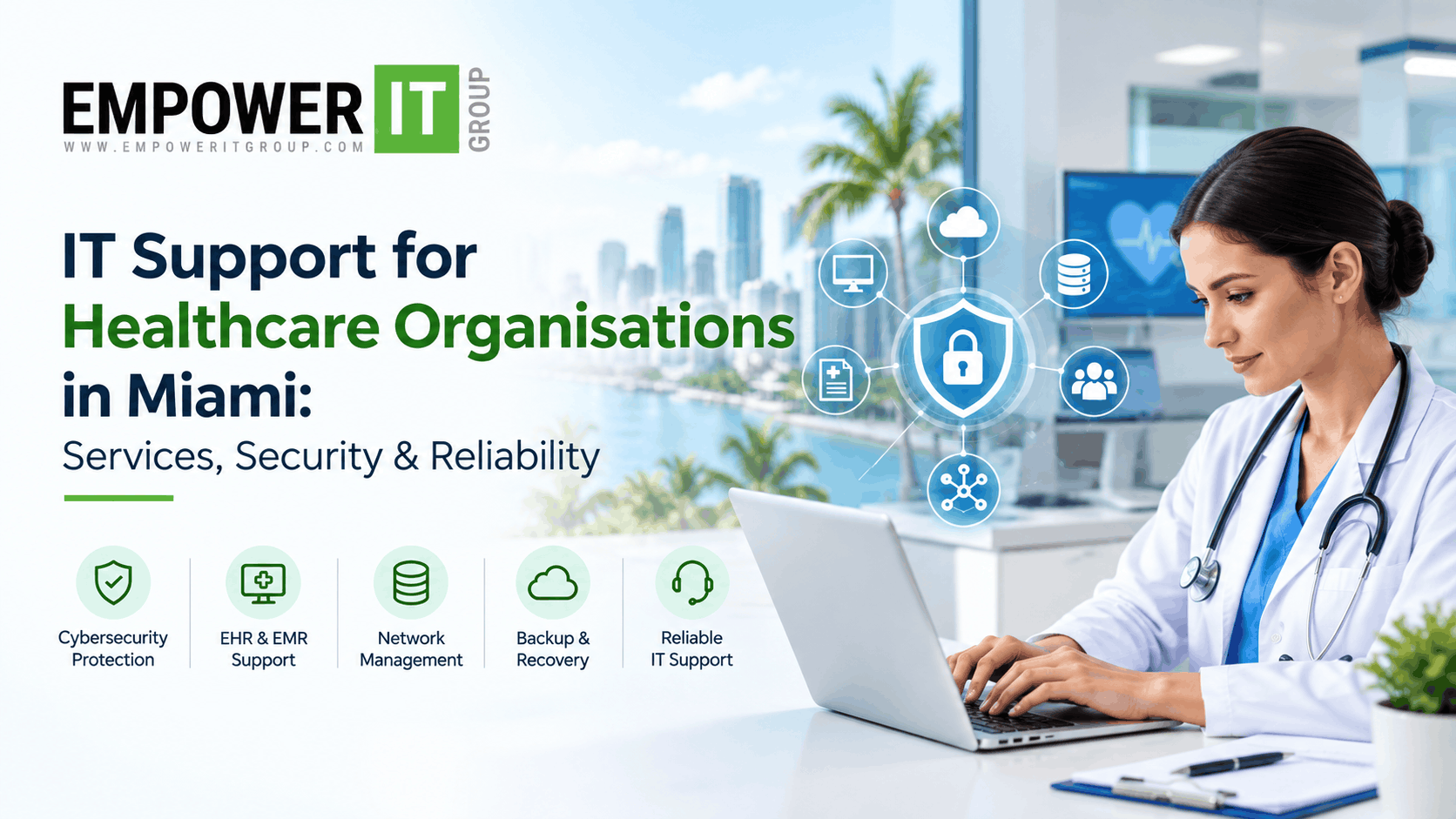
Healthcare organisations across Miami depend on technology to manage patient information, coordinate clinical operations, communicate with patients, and maintain essential administrative processes. From electronic health records and secure networks to connected devices and cloud applications, technology supports nearly every part of modern healthcare delivery.
However, managing healthcare technology involves challenges that extend beyond keeping computers and applications operational. Healthcare organisations must consider cybersecurity threats, sensitive patient information, system availability, data recovery, user access, and applicable regulatory responsibilities. A technical disruption can delay appointments, interrupt administrative workflows, affect access to clinical information, and place additional pressure on healthcare teams.
Professional healthcare IT support in Miami helps healthcare organisations manage these challenges through structured technical assistance, proactive maintenance, cybersecurity controls, and technology planning. With the right support arrangement, organisations can improve system reliability, address technical issues more efficiently, and build a stronger foundation for their digital operations.
For healthcare providers in Miami and South Florida, choosing an IT support partner that understands healthcare environments is an important step towards managing technology risks and supporting operational continuity.
This guide explains the services healthcare IT support can include, the importance of cybersecurity and compliance, and how healthcare organisations can evaluate an IT provider.
Why Healthcare Organisations in Miami Need Dedicated IT Support
Healthcare environments often combine clinical applications, administrative systems, connected equipment, digital communication platforms, and sensitive data repositories. These systems must work together while maintaining appropriate security and access controls.
A technology issue can affect several departments simultaneously. For example, a network interruption may prevent staff from accessing electronic health records, communicating with other departments, or completing administrative tasks. An account compromise may expose information that should only be available to authorised users.
Healthcare organisations also need to manage technology changes without unnecessarily disrupting clinical workflows.
Maintaining Access to Essential Healthcare Systems
Healthcare professionals and administrative teams depend on reliable access to digital systems throughout the working day. Slow applications, network failures, authentication problems, and hardware issues can delay important tasks.
Healthcare IT support helps establish processes for monitoring systems, reporting incidents, diagnosing recurring problems, and escalating issues that affect critical operations.
A well-defined support arrangement should identify which systems are essential, how incidents are prioritised, and who is responsible for resolving problems involving multiple technology providers.
Protecting Sensitive Healthcare Information
Healthcare organisations may handle patient records, medical histories, insurance information, billing details, and other confidential information.
Appropriate security measures help reduce the risk of unauthorised access, accidental disclosure, data loss, and malicious activity. These measures may include access controls, endpoint security, patch management, secure configurations, backup monitoring, and employee awareness.
The specific controls required depend on the organisation’s systems, risk profile, and applicable obligations.
Managing Increasing Technology Complexity
As healthcare organisations grow, they may add locations, employees, devices, applications, and digital services. Without consistent management, technology configurations can become fragmented, support responsibilities may be unclear, and security gaps can become harder to identify.
Healthcare IT services help organisations manage these changes through documented processes, standardised configurations, asset management, and ongoing technical oversight.
What Does Healthcare IT Support in Miami Include?
The scope of healthcare IT support varies according to the organisation’s size, technology environment, operational requirements, and service agreement.
| Service | What it covers | Operational benefit |
| Healthcare help desk | Technical assistance and incident tracking | Helps employees resolve technical problems |
| Network management | Connectivity, network devices, and secure configurations | Supports reliable access to systems |
| EHR and EMR support | Access, connectivity, troubleshooting, and coordination | Helps maintain access to clinical information |
| Cybersecurity management | Security controls, patching, and monitoring | Helps reduce exposure to cyber threats |
| Backup and recovery | Backup monitoring and restoration planning | Supports recovery after data loss or disruption |
| Device management | Computers, laptops, and approved connected devices | Improves consistency and maintenance |
| Identity and access management | User accounts, permissions, and access reviews | Helps restrict access to authorised users |
| Cloud and remote access support | Approved cloud services and secure connectivity | Supports controlled access to digital resources |
| IT infrastructure planning | Technology reviews and upgrade recommendations | Helps align IT with organisational requirements |
| Vendor coordination | Communication with software and equipment providers | Helps resolve issues involving multiple systems |
Healthcare organisations should confirm which services are included in the provider’s agreement, which require additional fees, and which responsibilities remain with internal teams or application vendors.
Healthcare Cybersecurity: Protecting Systems and Patient Data
Cybersecurity is a critical part of healthcare IT management because healthcare organisations depend on interconnected systems and handle sensitive information.
Threats may include phishing, stolen credentials, ransomware, malicious software, vulnerable applications, misconfigured systems, and insecure remote access. A single compromised account or unpatched device can create risks across connected systems.
Effective cybersecurity requires multiple layers of protection rather than relying on a single tool.
Endpoint Protection and Patch Management
Computers, laptops, and other supported devices should receive appropriate security updates and use suitable endpoint protection controls.
Outdated software may contain known vulnerabilities that attackers can exploit. However, healthcare environments sometimes rely on specialised applications or equipment that require compatibility checks before updates can be applied.
An IT provider can help maintain an inventory of devices, identify unsupported software, coordinate approved updates, and document exceptions that require additional risk management.
Identity and Access Management
Healthcare organisations should ensure that employees have access to the systems and information necessary for their responsibilities.
Role-based permissions, unique user accounts, multi-factor authentication, and periodic access reviews can help reduce unnecessary access. Accounts should be updated when responsibilities change and disabled promptly when access is no longer required.
Organisations should also understand how external support providers access their systems and ensure that such access is appropriately authorised and controlled.
Email and Phishing Security
Phishing emails can imitate trusted contacts, request sensitive information, or direct employees to fraudulent login pages. Healthcare employees may receive messages relating to appointments, invoices, documents, or operational requests that require careful verification.
Email filtering, authentication controls, security awareness training, and clear incident-reporting procedures can help reduce exposure.
Employees should know how to report suspicious messages and what steps to take if they disclose credentials or interact with a potentially malicious attachment.
Network Security and Segmentation
Healthcare networks may connect administrative workstations, clinical applications, printers, wireless devices, and specialised equipment. These systems do not necessarily require the same level of network access.
Appropriate network segmentation, firewall configuration, secure wireless settings, and controlled remote access can help limit unnecessary communication between systems.
Changes involving clinical equipment or specialised applications should be planned carefully, with compatibility and operational requirements considered before implementation.
Healthcare IT Compliance and HIPAA-Related Responsibilities
Healthcare organisations in the United States may have obligations under the Health Insurance Portability and Accountability Act (HIPAA), depending on their status and activities. Covered entities and relevant business associates must meet applicable requirements for protecting electronic protected health information.
Compliance involves more than installing security software. It may require administrative procedures, physical safeguards, technical controls, risk analysis, documentation, workforce training, and contingency planning.
Healthcare IT support can help implement and maintain relevant technical safeguards, but an IT service agreement alone does not guarantee compliance.
Security Risk Analysis
A risk analysis helps an organisation identify potential threats and vulnerabilities affecting the confidentiality, integrity, and availability of electronic protected health information.
The assessment should consider the systems that create, receive, maintain, or transmit this information, along with the risks associated with those systems.
An IT provider may help document infrastructure, identify technical weaknesses, review configurations, and recommend remediation measures. The healthcare organisation remains responsible for ensuring that its overall compliance programme meets applicable requirements.
Audit Controls and Documentation
Organisations should understand which systems record user activity, how relevant logs are maintained, and how suspicious activity is investigated.
Documentation can also help demonstrate how security risks are assessed, which safeguards are implemented, how incidents are handled, and when important system changes occur.
The level of documentation and the controls required depend on the organisation’s responsibilities and risk profile.
Business Associate Agreements
When an external IT provider handles electronic protected health information on behalf of a regulated organisation, the relationship may create business associate obligations under HIPAA.
An appropriate business associate agreement may be required, depending on the circumstances. Healthcare organisations should review the provider’s access, security practices, contractual responsibilities, and incident reporting arrangements.
Organisations should not assume that using an IT provider automatically satisfies their regulatory obligations.
EHR and EMR Support for Healthcare Organisations
Electronic health record (EHR) and electronic medical record (EMR) systems support important clinical and administrative activities. Depending on the platform, they may be used for patient histories, documentation, scheduling, prescriptions, billing, reporting, and communication between authorised professionals.
When these systems experience technical problems, the effects can extend across multiple departments.
Healthcare IT support may help troubleshoot connectivity, workstation configuration, user access, network performance, and approved integrations. The provider’s role should be clearly defined, particularly when application-specific support is handled by a separate vendor.
Resolving EHR Access and Performance Problems
Common problems include slow loading, login failures, interrupted connectivity, printing errors, permission issues, and difficulties accessing related applications.
The cause may involve the local network, workstation, server, identity configuration, cloud service, or application itself.
A structured troubleshooting process helps identify the source of the problem and route it to the appropriate technical team.
Supporting Integrations and Connected Systems
Healthcare organisations may use several systems that exchange information or support related workflows. Changes to network settings, software versions, devices, or permissions can affect these connections.
Before implementing major changes, teams should identify dependencies, document configurations, test where appropriate, and establish a recovery or rollback procedure.
Where clinical software or connected medical equipment is involved, changes may require coordination with the relevant vendor to protect compatibility and operational continuity.
Backup, Disaster Recovery and Business Continuity
Healthcare organisations need to prepare for events that could make essential systems or information unavailable. These may include hardware failure, accidental deletion, cyber incidents, infrastructure outages, or other disruptions.
Backups are an important part of recovery, but they are only useful when they are appropriately configured, protected, monitored, and capable of restoring the required information.
Establishing Reliable Backup Processes
A backup strategy should identify the systems and information that need protection, how frequently backups run, how long data is retained, and who can access backup copies.
Where appropriate, organisations should consider protected or isolated backup arrangements to reduce the risk of a single incident affecting both production systems and backup data.
Backup responsibilities should be clearly documented, including which systems are covered and how exceptions are handled.
Testing Recovery Procedures
A successful backup job does not necessarily prove that a system can be restored within the required timeframe.
Periodic restoration testing helps identify problems with backup integrity, missing data, credentials, system dependencies, or recovery procedures.
Healthcare organisations should define realistic recovery objectives for essential systems and document the responsibilities of internal staff, IT providers, and application vendors.
Planning for Operational Disruption
Business continuity planning should identify how the organisation will respond when technology is unavailable.
This may include incident escalation, communication procedures, approved temporary workflows, recovery priorities, and the conditions for returning to normal operations.
The plan should reflect the organisation’s clinical responsibilities and be reviewed when systems, locations, or operational requirements change.
How Managed Healthcare IT Services Improve Reliability
Managed IT services provide ongoing support for an agreed set of technology responsibilities. For healthcare organisations, this can create a more structured approach to maintenance, incident management, security, and infrastructure planning.
Proactive Monitoring and Maintenance
Where included in the service agreement, monitoring can help identify unusual system behaviour, capacity issues, and certain technical failures.
Scheduled maintenance and patch management can also address some problems before they cause significant disruption.
Monitoring does not prevent every incident. Healthcare organisations should still maintain clear escalation procedures and appropriate recovery arrangements.
Structured Help Desk Support
A central support process helps employees report technical problems, track requests, and receive updates.
Defined priorities can help ensure that incidents affecting critical systems receive appropriate attention. Organisations should confirm support hours, response targets, escalation arrangements, and any after-hours coverage before selecting a provider.
Standardised Device and User Management
Consistent device configurations and documented user-management procedures can make technology easier to maintain.
This may include preparing devices for new employees, applying approved security settings, managing software, reviewing permissions, and removing access when no longer required.
Standardisation can also make it easier to identify devices that fall outside the organisation’s expected configuration.
Technology Planning and Lifecycle Management
Healthcare organisations need to plan for equipment replacement, application requirements, infrastructure capacity, and future growth.
An IT provider can help assess the current environment, identify ageing or unsupported technology, and prioritise improvements according to risk, cost, and operational impact.
A technology roadmap can help organisations avoid relying entirely on emergency repairs and unplanned purchases.
How to Choose a Healthcare IT Company in Miami
Selecting a healthcare IT company in Miami requires evaluating technical capabilities, security responsibilities, support processes, and the provider’s ability to work within a healthcare environment.
1. Review Healthcare Experience
Ask about the provider’s experience supporting healthcare organisations and the technology environments it understands.
Discuss the systems your organisation uses, the support requirements of clinical and administrative teams, and how the provider coordinates with specialist software or equipment vendors.
2. Evaluate Cybersecurity Services
Ask which security controls are included and how the provider manages patching, endpoint protection, access controls, monitoring, and incident escalation.
Confirm whether monitoring is continuous or limited to specific hours, who investigates alerts, and what happens when an incident requires specialist assistance.
3. Clarify Compliance Responsibilities
Discuss the provider’s role in supporting applicable HIPAA-related safeguards, documenting security controls, and responding to incidents involving protected information.
Review relevant contractual responsibilities, including whether a business associate agreement is required.
The organisation should understand which obligations are supported by the provider and which remain its own responsibility.
4. Confirm Service Availability and Response Targets
Ask how incidents are prioritised, what response times apply, and whether critical systems receive a different level of support.
Confirm whether support is available outside standard business hours and whether emergency coverage includes the systems your organisation considers essential.
5. Compare Pricing and Service Scope
Review the recurring fee, included services, onboarding costs, project charges, hardware and software expenses, contract terms, and exclusions.
A transparent proposal should explain what the organisation receives and how additional work is billed.
6. Assess Communication and Reporting
Regular reporting can help healthcare leaders understand recurring incidents, unresolved risks, maintenance activities, and planned improvements.
Ask how often service reviews occur and whether recommendations are prioritised according to operational impact and risk.
Why Choose Empower IT Group for Healthcare IT Support in Miami?
Empower IT Group helps healthcare organisations assess their technology requirements and identify opportunities to improve IT management, security, and operational reliability.
For organisations in Miami and South Florida, an effective IT support strategy should account for the systems used by clinical and administrative teams, the sensitivity of information handled, the consequences of downtime, and the organisation’s future technology needs.
An assessment can help identify recurring technical issues, review device and network management, evaluate access controls, examine backup arrangements, and establish priorities for improvement.
The appropriate support arrangement depends on the organisation’s infrastructure and requirements. Before entering an agreement, healthcare leaders should clarify service coverage, security responsibilities, incident escalation, reporting, and any additional charges.
By aligning technology management with operational priorities, Empower IT Group can help healthcare organisations make more informed IT decisions and establish a more dependable foundation for their digital operations.
Conclusion
Reliable IT support helps healthcare organisations maintain access to essential systems, manage cybersecurity risks, protect sensitive information, and support daily clinical and administrative operations.
For healthcare organisations in Miami, an effective approach combines technical assistance, preventive maintenance, security controls, backup and recovery planning, and clear accountability. The right service arrangement should reflect the organisation’s technology environment, operational priorities, and applicable responsibilities.
The first step is to assess existing systems, identify recurring problems and security gaps, and determine which IT responsibilities require ongoing support.
Empower IT Group can help healthcare organisations in Miami evaluate their technology needs and identify practical ways to improve IT reliability, security, and support.
Frequently Asked Questions
1. What does healthcare IT support in Miami include?
Healthcare IT support may include help desk services, network management, device maintenance, EHR and EMR troubleshooting, cybersecurity, backup monitoring, access management, cloud support, and technology planning. The exact scope depends on the organisation’s requirements and service agreement.
2. Why do healthcare organisations need specialised IT support?
Healthcare organisations rely on clinical systems, manage sensitive information, and need dependable access to technology. Specialised IT support helps manage these systems, address technical problems, maintain security controls, and prepare for disruptions.
3. How can healthcare IT services help protect patient information?
Healthcare IT services can help implement access controls, multi-factor authentication, endpoint protection, security updates, monitoring, and backup arrangements. These measures can reduce certain risks but should form part of a broader security and risk-management programme.
4. Does healthcare IT support guarantee HIPAA compliance?
No. IT support can help implement and maintain technical safeguards, document systems, and support risk management. However, compliance involves broader organisational, administrative, physical, and technical responsibilities. Healthcare organisations remain responsible for meeting their applicable obligations.
5. Can an IT provider support EHR and EMR systems?
Yes, depending on the provider’s capabilities and agreement. Support may include connectivity, workstation configuration, user access, network performance, and coordination with the application vendor. Organisations should clarify whether the provider supports the application itself or only the surrounding infrastructure.
6. What is the difference between managed IT services and break-fix support?
Break-fix support generally responds to problems after they occur. Managed IT services provide ongoing support under an agreed arrangement and may include monitoring, maintenance, help desk assistance, and cybersecurity management. The service scope and responsibilities should be confirmed in the contract.
7. How can healthcare organisations reduce IT downtime?
Organisations can reduce avoidable downtime through preventive maintenance, appropriate monitoring, supported software, secure configurations, tested backups, documented recovery procedures, and clear incident escalation. No approach can eliminate every outage, so continuity planning remains essential.
8. Should a healthcare organisation have 24/7 IT support?
The appropriate support hours depend on operating schedules, the importance of essential systems, risk exposure, and recovery requirements. Organisations with round-the-clock operations or critical systems may need after-hours support. They should confirm which incidents and systems are covered.
9. How much does healthcare IT support cost in Miami?
Costs vary according to the number of users and devices, infrastructure complexity, support hours, security requirements, locations, and services included. Healthcare organisations should compare complete proposals rather than relying only on the monthly fee.
10. How often should healthcare IT systems be reviewed?
Monitoring and routine maintenance should continue throughout the year. Formal risk and technology reviews should occur according to applicable obligations, organisational risk, and significant changes to systems or operations. Reviews should also follow material incidents or the discovery of important vulnerabilities.